I bought my first pot of African violet a few months ago. While the newly acquired African violet is blossoming beautifully, I didn’t aware but only until another gardener pointed out to me that my African violet actually had multiple crowns.
As a curious gardening novice who like to try different things, I decided to take up this challenge and separate the crowns. It has been almost three months since I separated the crowns. Seeing that the separated crowns of my African violets are now growing healthily, I consider this “operation” as a successful one. And here, let me share with you how I did it.
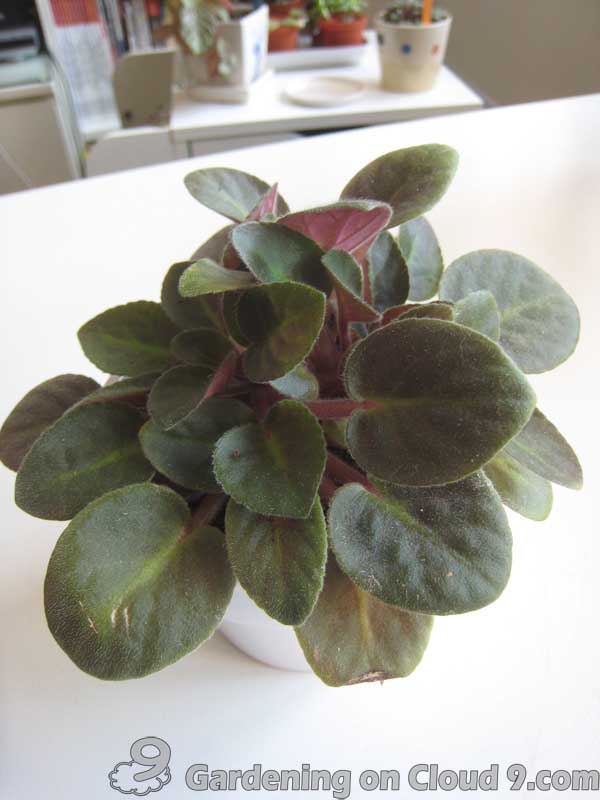
This was my African violet three months ago. As you can see, the plant was very messy, jam-packed with its leaves shooting to all directions.
First, I allowed my African violet to dry slightly so the compost was loose and the leaves were rubbery. This helps preventing the roots and leaves from breaking easily when one tries to separate the crowns.
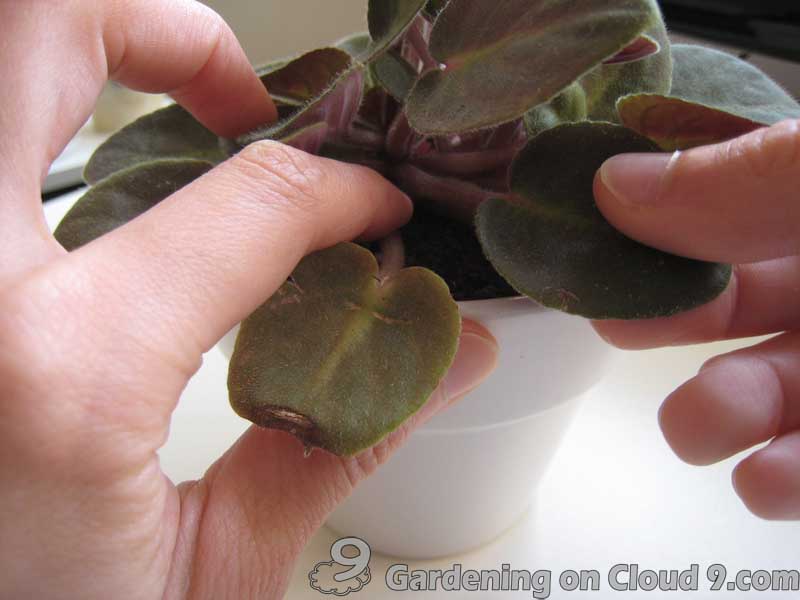
I picked out all the unhealthy leaves from the plant. You can also do this after removing the plant from its pot.
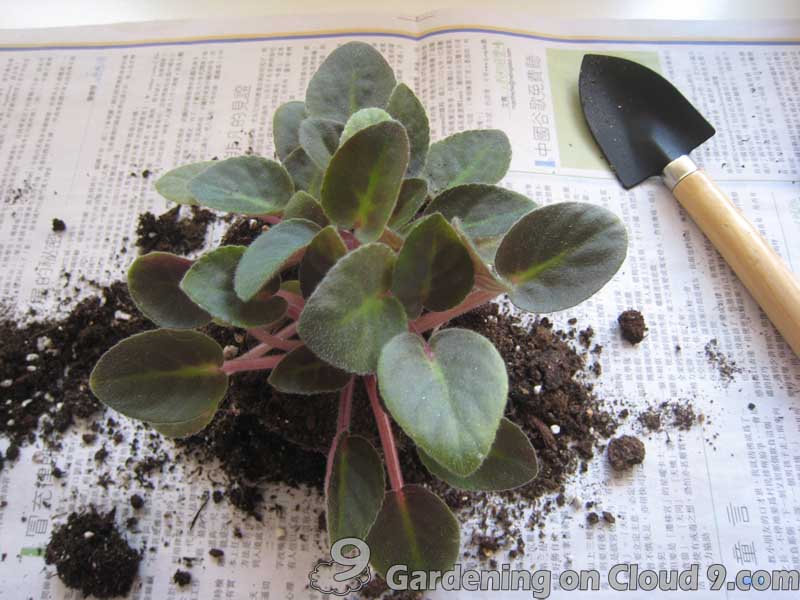
Then I removed the plant from its pot, shook away any excess compost and exposed the root ball.


After some careful examination, I found two distinct root systems. With a clean sharp knife, I cut between the root systems. I feel like a doctor doing a surgery.
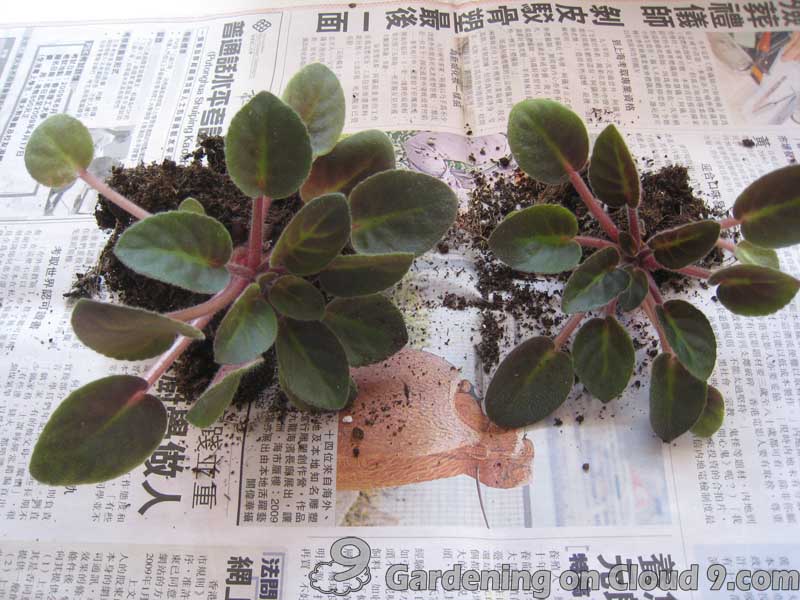

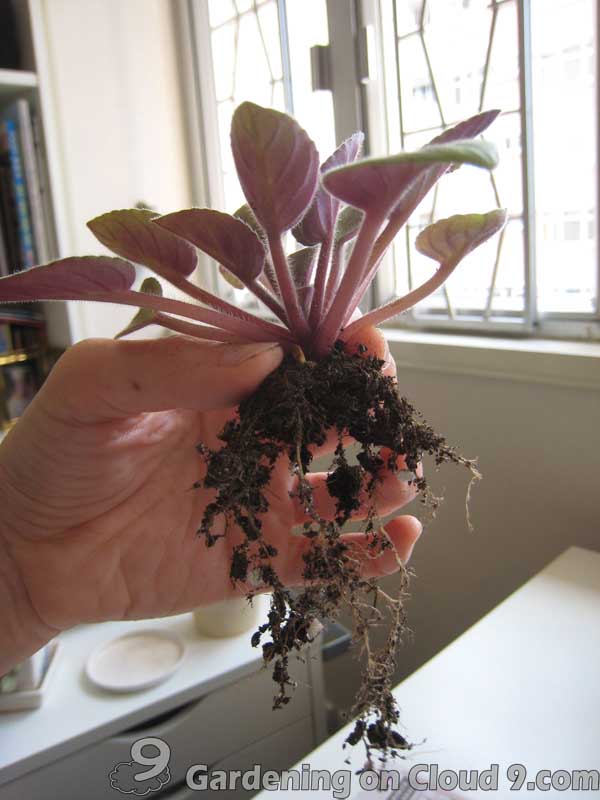
Since there were existing roots on the crowns, both of them could be placed directly into fresh compost. If the crown is an offshoot without its own root system, then it is better to first be placed in water to permit root development.
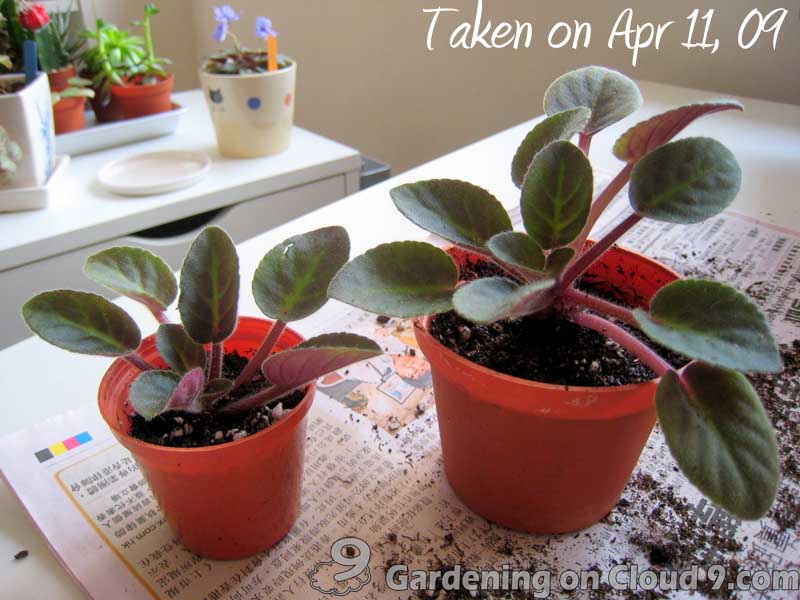
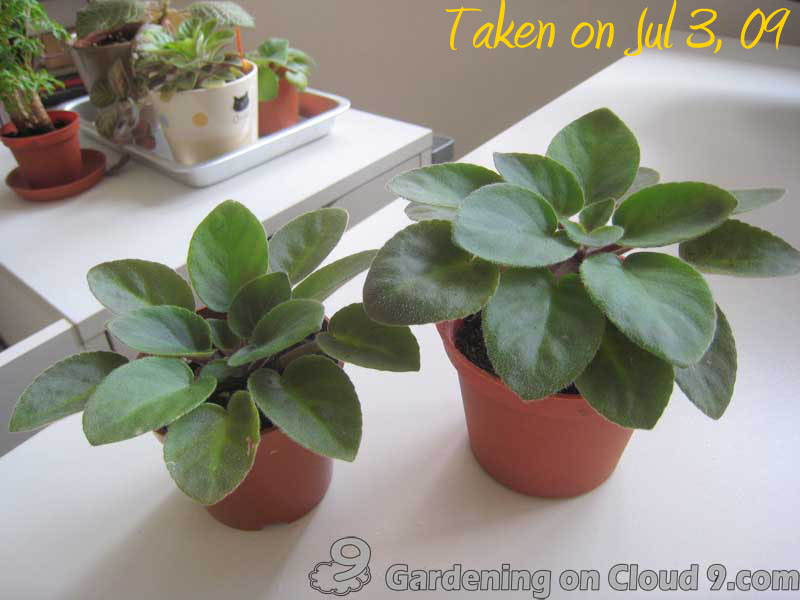
The two African violets, which I have separated there months ago, are growing strong and healthily now.






This is so good Sandy! Thank you for showing the process. I have not planted African Violet before. Maybe one day I will try. I was told you can’t let the leaves go wet right? otherwise the leaves will rot. That means water the base/root only right?
Yes Stephanie, we shouldn’t keep the leaves wet. I always dry the leaves if they get wet after watering 🙂
I transfer my African Violet to outdoor under the tree, and it’s still survive over the cold winter. Amazing! Thanks for your wonderful post, I’m enjoying your blog, just add it to my favorite blog list.
Wow, surely amazing it is! Vue Jardin, where do you live? Sounds like you have a very hardy African violet if it can grow outdoor and survive over a cold winter huh 🙂 And thank you for adding my blog to your favorites.
I need some suggestions for my African violet! I have had it for about three years and it has only bloomed once…when I first got it. I just recently transferred it to an “African violet” pot. It’s just one pot inside another really. Do I need to seperate it somehow?
Hi Lisa,
If your African violet is growing beautifully, with green leaves and healthy roots, but only that it never flowers, then it is mostly a problem of fertilizer or insufficient sunlight. Fertilize your African violet with a relatively high concentration of phosphorus (the P in N-P-K). As for sunlight, African violet prefers bright, indirect sunlight. It will stop blooming if we put it on the coffee table in the middle of the living room where there is little light. Hope this help 😉
Happy gardening!
Hi I have never repotted an African Violet and about to try it from your advice I have read on here.
I have been lucky enough to propogate some leaves thta have grown and was wondering if a bonsai pot could be used or are they too shallow?
Many thanks hope to hear from you soon
Hi Debbie,
How big is the bonsai pot? African violet likes to grow in a small pot. For a baby African violet with just a few leaves, a 1.5″ pot will be perfect.
Happy Gardening! 🙂
Hi. I am young and I love growing many African Violets. But I have never had more than one crown before. I have three Violets, two just babies, but one that has four different crowns. They are all getting very big. What do you do if you don’t have the time to slightly dry the soil?
Hi Jewel,
Do you mean that you can’t wait till the soil is dried up before separating the crowns? It is okay if the soil is slightly moist. But we have to be extra careful when handling the roots. It is easier to damage the roots when the roots and soil are wet.
Hope this help. Happy gardening!
Okay. Thanks. I am actully just about to begin. I hope that I do it right! But if I accidently snap off a leaf, can I just put it in water to have it sprout roots?
Hi. I just bought a plant, but I was wondering, where can I learn what type of violet I have, and do different types grow different? Also, what does it mean if the edges of my leaves are brown?
I hope you answer soon.
Hi Diana, I borrowed a book from the library with photos and names of different types of African violet. I bet there are many books as such available in your local book stores, or online.
When the edges of the leaves have turned brown, your plant may have been burnt due to over-fertilizing. And if all the leaves of your plants are dropping really low, you may have put your African violet in an area too sunny.
I do not fertilize my Violet. I don’t have any. So I make do without. I consider myself very successful for still having a beautiful, healthy plant.
But I also do not think that I give it too much light. I have several violets, and it is only one of them that I have this problem. Also, do you really need to keep your violet in a humid place? If so, then I might need to.
hi,
this is the first time for me to get an african violet, I like it alot, but I want to put it outdoor, not in my garden… but in the center of an outdoor table, where there is no direct sunlight, so Is it ok to do this? also I read that it should be kept dry, do you mean if the leaves get wet, they dont live longer? so what if it will rain or windy, should I bring it inside?
Thanks.
P.S: I am new in gardening.
Hi Nada,
Due to its sunlight and temperature requirements, African violet is best suitable to be grown indoor. African violet should be grown in temperature between 60-80 degrees F. If the weather drops lower than 60 degrees or rises higher than 80 degrees, the plant will suffer (ie: the plant may go into shock and begin to wilt). And it is definitely easier to control indoor temperature than outdoor one.
Have fun gathering!
Hi, it is me Jewel again. So it has been about six months since I separated my violets, and I got three nice plants. But then recently and out of the blue, my baby violet, the very smallest, leaves went limp. Then they got a yellow tinge to them. The poor thing died and I couldn’t do anything. But I assumed that it was just to small for it’s pot, because I couldn’t give it a smaller pot. But now, my second smallest is showing the same symptoms, and it seems to fit it’s pot quite well. I’ve tried giving it more light, extra water, and even less water, but nothing has helped. So now I say for it, Help!
Jewel
Hi Jewel,
While there can be many reasons that cause limp leaves/stems, the most common reason of all is probably overwatering. This may be caused by a pot too large (http://www.gardeningoncloud9.com/200904/african-violet-container-size/) . Or you may have just given it a bit too much attention and water it a bit too often.
Happy gardening!
Okay thanks! I hope that helps. I hope that I see an improvment. My violet had been in an African Violet Pot. But maybe it just isn’t the right pot for this little guy? Although, my pot is rather large for my violet because my violets leaves barely reach the edge of the pot! Do you think that this also could be causing it to wilt?
Please answer soon!
HI Sandy!
I am worried about my african violets! I had three plants that looked very healthy, as I told you once. And then they started to wilt. Well, I didn’t let them dry out, but I wasn’t watering them too much, but now two of my plants are dead! I am extremly scared that my third one will also wilt and die.
But I was looking on different sites for help, when I found that Urea is harmful to african violets and is often found in African Violet Fertilizer. Well, I checked my fertilizer, and it has Urea in it! I read that Urea causes roots to rot. How do I check to see if my roos are roting? Could that be what is killing my violets?
I hope you answer soon, because I am extremly worried for my last little fella.
Jewel
“This helps preventing the roots and leaves from breaking easily when one tries to separate the crowns.”
Can about it more?
I mean it is better not to separate the crowns right after watering or when the soil is still wet. The soil is messy and heavy when it’s wet. And the roots and leaves of the plant are wet, they are more brittle, and easier to cause damages.
Will we see an update o these violets. Did you get bitten by the violet bug? I own over 60 African violets. I just love to propagate them and give them away.
Hi Sandy, I have great luck with my violets and many are always in bloom, the problem I’m having with one is it’s gotten quite “tall” or leggy. It’s only one plant, no off shoots, The lower leaves are dropping off slowly. I’d like to save it or start a new one from it. How would I go about doing that? I’d prefer to use the plant at the top which looks wonderful and is blooming, it’s just sitting on top of a long stem?? any help would be appreciated. Thanks Donna
Hi Donna,
My teacher told us that we can cut our AV shorter. Because I have been very busy recently, even though my AV needs this operation, I have never had the time to do this. It looks risky, but I trust my teacher. You can give it a try 🙂
The AV should have roots by 18-20 days. Feed your AV with fertilizer that has high Nitrogen 1.5-2 months after this operation. Don’t fertilize it any earlier.
Hope this help. Happy Gardening!
You can also propagate your African Violet with the leaves you cut 😉
hi sandy, I have a large AV it’s about 2 feet across.with multiple crowns.I’m so afraid to seperate them. But I know I need to.I have no problem rooting leaves in water.just a piece of advice .water from the bottom,use water that has sat over night,and don’t move them around alot.I’ve done great with these simple rules.Looking for a yellow bloom.good luck all.
Tennie, thanks much for your sharing 🙂
Sandy..before I found your page, I separated my huge multi-crowned Africian Violet which was really healthy but overcrowding the pot and was looking really bunched up. When I removed the plant onto my worktable, the plant actually separated where it wanted to break and I ended up with three plants. One however, did not have many roots attached but I planted it in some good AV soil and watered it. Today (day 3 after separating) it looks, like the leaves are droopy. The other two plants look fine. Do you think I should “Unplant” it and suspend it over a bowl of water so that just the bottom stalk piece is in water? What would you do? Thank you.
Hi Patricia,
I would suggest not to put the AV that has little roots in the water, but keep it in the soil. When plants don’t get the water that they need, they would try to grow and extend their root systems, in the hope of finding water sources. So you could try to water this AV less than what you normally would do and see if you could encourage your AV to grow more roots.
Happy Gardening!
Sandy
Thanks for your wonderful suggestions! I have three african violets that were from my grandmother (or descendants of hers). My grandma died when I was 10 and I’m 47! I tell you this so you understand the pressure I am feeling as my biggest of the African Violets is suffering. We have recently moved so it got jostled quite a bit. Then, unfortunately, I put it outside thinking it would like some sun. Reading your blog, I see that wasn’t a good idea. The other problem, the stalk has grown so high that there is at least two inches of stem hanging over the pot and a lot of roots exposed. Every day my heart hurts looking at it but I don’t know what to do for it. I did fertilize it when we arrived, but it was a general household fertilizer, not specific for African Violets.
Hi Margie,
Thanks for your sharing. Seems like your African Violet needs to have a root trim and be repotted. If you don’t know how to trim the roots, then at least repot the plant. In addition, don’t fertilize a plant when it’s weak or not in a good healthy state. So, I would suggest you not to fertilize your African Violet but only until it has settled in its new environment.
I can imagine how important and significant these 3 African Violets are to you. Don’t stress too much and hope your African Violets keep growing strong and healthy 🙂
I am SOOO happy to find your blog!! I have gradually inherited several AVs over the years, although it was never intentional – didn’t think I could grow them because I had heard they were difficult to grow, but they have thrived! Because I am sentimental, I have given each of them names and talk to them a lot, now that I’m retired. I also thank them for their flowers and carefully let out my warm breath over all their leaves when I water them weekly, since plants take in carbon dioxide – I like to imagine that it’s the equivalent of my being given a whiff of pure oxygen every so often (it’s OK – I don’t care if people think I’m eccentric, I have gorgeous plants!). I will eagerly be trying your teacher’s method of shortening “Violet’s” roots and separating the two large AVs (collectively called “Santa”) when spring comes, so thank you very much for explaining the procedures. Your blog is just what I needed!
I have 4 African violet plants in a north east window for years and have been doing well till now. Two of them lean way over the AV pot and roots show. I am trying to repot them – one I did ok but the other small one has a very long root. I am looking for a large AV pot to repot it but I am reaading your blog and guess I can cut it shorter and re pot in a smaller AV pot. Is this right? Also I at times fertilize them with water from egg shells and they do well.
Hi Joan,
Thanks for sharing your experience.
Yes, spring is a good time to do root trimming and repotting.
Just what I needed, thank you. Clear and easy to follow. I find wetting the leaves no problem, for, as my grandson said “They’d get wet where they grow outdoors, grandma”. However the water does need to roll off.
Suddenly my beautiful, healthy AV leaves have developed brown edges on almost every leaf……What am I doing wrong?
I have several African violets and it seems like they LOVE to propagate! Is there something I can do to stop them from growing babies as I HATE to throw away any of them when I separate them. You may think this is a funny question but does having the plants close to each other make them prone to propagating from some sort of pollination? One of my AV’s is very huge and about a year ago I put it in a larger pot – it, too, is now growing babies and getting larger than ever!