Here are my top ten indoor gardening tips for gardening novices.
Tip 1 – Choose the Right Plant
Before you bring a houseplant into your house, you just have to make sure you can give what it needs to grow healthily. Choose only those plants that will be able to grow in the climate and condition of your room. Here is a list of suitable houseplants with photos for indoor gardening that you may find helpful.
Tip 2 – Enough Sunlight?
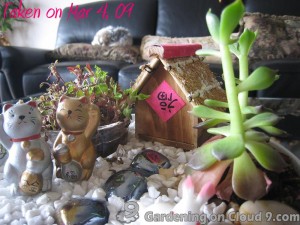 Like oxygen and water, plants need sunlight to grow healthily. If your house does not have a lot of sunlight, and if you are not planning to use any artificial light, don’t worry, for you still have many options to choose from. Different types of houseplant require different amount of sunlight. There are many types of plants that thrive in medium to low light conditions, such as African violets, Boston ferns, Spathiphyllum, Philodendrons, and many more.
Related Post about Light Requirements
My Echeveria is Growing Way Too Tall!
Tip 3 – Rotate Your Indoor Plants
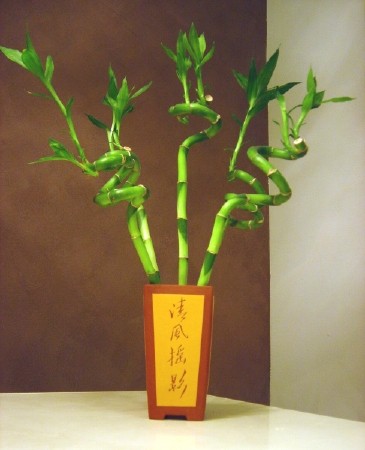 Plants have the tendency to reach towards the light source. In fact, this is how one can make a bamboo curl up – by covering the whole plant with a container, but leaving only a small hole, to manipulating the light condition as the plant grows.
And for the indoor plants, the light source is usually where the windows are. Hence, it is necessary to rotate your plants occasionally in order to keep them growing straight.
Tip 4 – How Much to Water?
Improper watering is probably the number one cause of death for most plants. And overwatering is usually more of the problem than underwatering. A rule of thumb for watering potted plants – water the houseplant only when the soil mixture feels dry to the touch. And when you do so, you should water the plant thoroughly until water drip from the drainage hole of the pot. Light watering does your plant no good, for it only wets the surface of the soil, but not the root.
Related Posts about Watering Indoor Plants
Gardening Journal – They Just Want More Water!
Instructions of Watering My Tabletop Garden – Bento Box
Guildlines and Watering Tips of Crystal Soil – Watering Plants in Crystal Soil
Watering Tillandsia (a.k.a. Air Plant)
Tip 5 – When to Water?
For most plants, the best time of day to water is in the morning. This gives the plant time to absorb the water and get ready to handle heat, cold, or just the energy it takes to produce chlorophyll, grow, and move nutrients around.
Tip 6 – Choose a Gardening Container
For gardening beginners, I vote for plastic pots. There is no doubt that plastic pots make things simpler and easier for gardeners. Plastic pots are durable, shatter proof, and unlike those clay pots, they keep the soil from drying out too quickly. In addition, while many ceramic pots do not have drainage holes due to their decorative qualities, plastic pots always have drainage holes to avoid overwatering and other drainage problems. Also, the light in weight of plastic pots makes it easy for gardeners to check whether the soil has been dried up and if watering is needed.
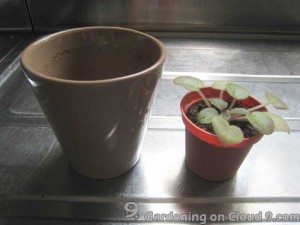 But I also agree that most plastic pots are just plain and boring. In fact, I have made many tabletop gardens and home decorations using different types of container as my garden containers. If you want to have some fun in indoor gardening, making your own container or tabletop gardens, here are some posts showing you how to make some cute tabletop gardens and container gardens for home decorations.
Related Posts about Gardening Containers
Magic Bean Day 13 – Container Size Matter
How to Choose Garden Container and Indoor Plants for Tabletop Garden – Bento Box?
My African Violet Doesn’t Like Its Big House
Tip 7 – Keep a Record
Keep a record of each of your plants’ name, species, purchase date, fertilizer dates, repotting dates etc just as you would maintain your child’s medical reports. It will help you to maintain your plants systematically.
Related Post about Keeping a Record
Keeping a Garden Journal
Tip 8 – Fertilize the Potted Plants
Potted plants have nowhere to go for feed apart from the soil in their pot, so it is crucial that you fertilize your potted plants regularly.
You can add in a small amount of liquid fertilizer when watering your houseplants. Some plants go dormant in the winter, so you should avoid fertilizing in the winter. You may find it helpful to keep a record of your fertilization dates. And if you fertilize your plants too much or too often, you will end up burning your plants.
Tip 9 – Soil Is Not Our Only Choice
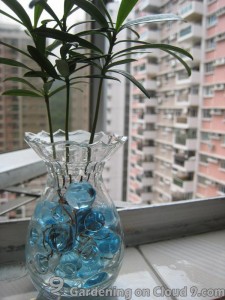 Besides soil, there are many other types of growing medium we can use for indoor gardening. Many houseplants, especially some foliage plants, thrive when they are planted in water (here you can find more about hydroculture – the dirt-free way of gardening). In addition, we can also use crystal soil, a beautiful, jello-like growing medium, for our smaller potted plants (here you can find more about crystal soil).
But of course, soil has its merit. In some cases, soil is still the most suitable growing medium for gardening. And like all other growing medium, soil is an integral for a healthy plant. If we are growing your plants in a container, we should avoid using soil from the garden. It will not yield good results. Besides, it may also risk insects, weeds, and other diseases to our potted plants.
In addition, we may need to add different types of soil amendment into our soil mix. Soil amendment is any material added to the soil to improve its physical properties, such as water retention, permeability, water infiltration, drainage, aeration and structure. The goal is to provide a better environment for roots.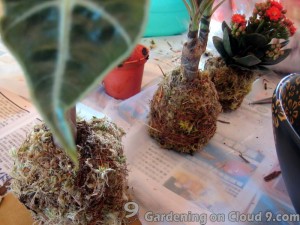
Here are some posts introducing different soil amendments.
Horticultural Charcoal for Indoor Gardening
Sphagnum Moss & Sphagnum Peat Moss
How to Wrap Pots or Roots with Moss
Tip 10 – Good Drainage
Almost all gardening guides tell us to use only pots with proper drainage holes. And without proper drainage holes, the excess water in the soil can go nowhere but stay in the pot, damage the roots, and your plant will almost certainly die…
Yes, all of this is true. Pots with drainage holes make life of a gardener easier. They take away the uncertainty and make the task of watering our plants much simpler – just water slowly and thoroughly till water dripping from the drainage hole. That’s easy. No guesswork is needed anymore!
But let’s face it. Sometimes there is a beautiful pot without a drainage hole that we just want to use… So what should we do? Let me post a few suggestions for potting houseplants using containers without a drainage hole later.
 Related Post about Drainage of Garden Container
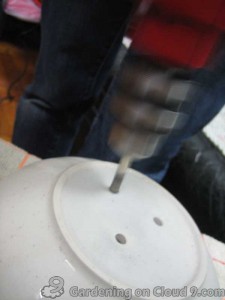
Drilling Drainage Holes by Ourselves






thanks for the pointers! i’m going to try the gardening journal, because i regularly forget which things i did to which plants, and when! 😛
i wish i’d read this before i planted my coleus in a funny shaped planter with no drainage holes, and no rocks on the bottom…
it’s shaped like a butterfly, and it stands like an “n” shape on the table, if that makes any sense…
i guess i won’t try to drill any holes in this one, as the bit is about as wide as the space i’d be drilling! 🙂
anyway, thank you for your site. I’ve enjoyed reading your articles even if i don’t comment on each of them, and feel i’m learning alot from your experiences.
thanks again!
~LiLi~
Thank you LiLi. I am happy that you have found my site helpful 🙂 For me, I use an excel file for my gardening journal, as well as lots of photos taken with my digital camera. A picture is worth a thousand words. I have found them very helpful, especially for keeping track of my plants’ conditions.
Howdy please excuse my english, I am not a native speaker. I found your article on RSS directory “Ten Indoor Gardening Tips for Gardening Novices | Gardening on Cloud 9” was essentially close to what I was search for, but after browsing through your blog post I still was not able locate straight-forward solution to my problem and this is driving me crazy. I like your website and think it is undoubtedly handy but I think you could make it even better if you fine-tune your blog search to make it easier for searchers to locate information within your website. You can get this done by installing WordPress addon… I think plugin was called search everywhere it has numerous useful options like search highlight, search comments. If you have any questions about configuring enhanced website search you can always contact me at Filsaime9@yahoo.com Thank you I hope you have a great day
Hi Sandy
It’s Peter here from Beginner Indoor Gardening. I’d just like to say that I love this page! A fantastic selection of tips for new gardeners. Thanks for your contribution to the gardening community.
Regards
Peter
I recently bought a nice house plant forget the name of it though. I wondering if i put too many fertilizer sticks in it cause the leaves are turning brown. Its growing very wide but can u give me advice about the leaves.
Hi Nancy,
Without knowing anything about your plant and the fertilizer you used, it is hard to tell. But I bet you probably have put too much fertilizer. For fertilizer, it is always better to under-fertilize than over-fertilize. There probably is a lot of fertilizer in the soil now. You can repot your plant with some new soil. And don’t use fertilizer anymore but only until the plant is totally healthy again. Hope your plant will be back to a healthy one again.
Happy gardening!
Greetings, can one cut these indoor bamboo plants to control their height? If so, where should one cut?
Thanking you
Mark Moses